
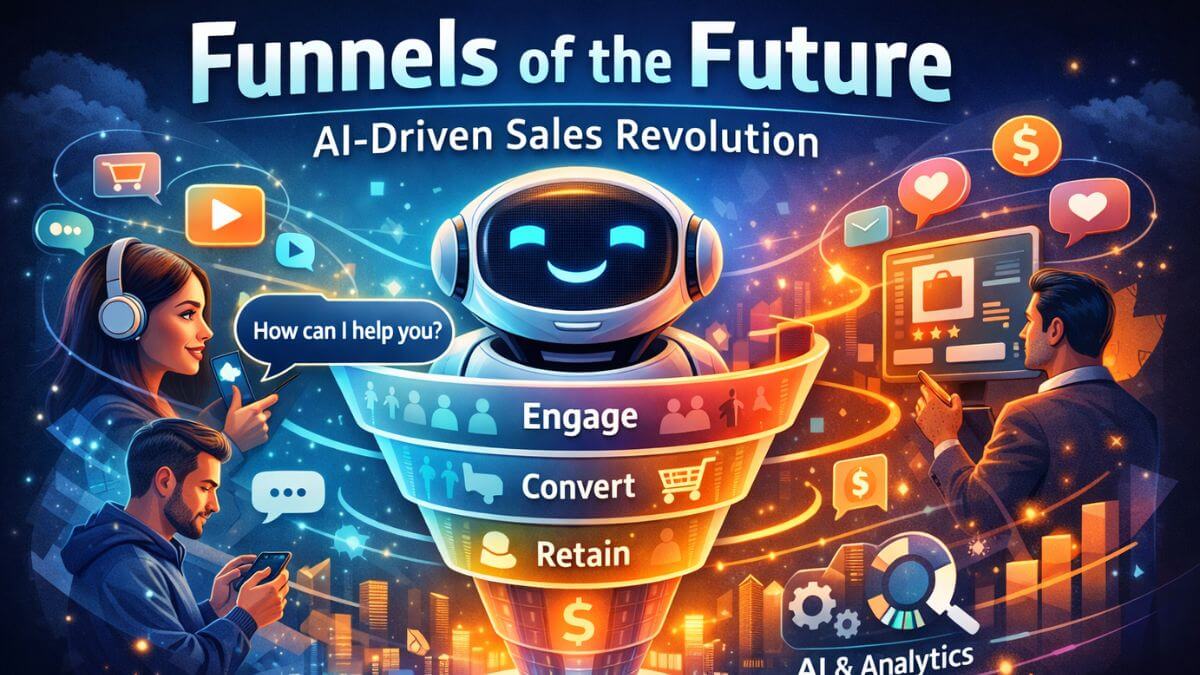
AI‑Driven Funnel Evolution: How Voice Concierge Transforms Sales Funnels
Most websites still rely on forms and chatbots that interrupt visitors instead of helping them. In this article, we explore how voice-first AI and automation are changings redefine funnels, and what this means for businesses that want higher conversions without adding staff or complexity.
Introduction
Marketers once imagined customer journeys as a simple linear progression from awareness to interest, decision and purchase. In reality, buyers no longer follow a straight path; they switch between channels, browsing social media, watching videos, messaging friends and shopping in unpredictable ways. This non‑linear behaviour causes significant drop‑off and wasted advertising spend when businesses rely solely on traditional funnel models. With the rise of voice assistants and artificial intelligence (AI), companies now have the opportunity to turn static funnels into dynamic, interactive experiences that meet customers wherever they are. This post explains how Voice Concierge, a platform built on Go High Level, helps businesses optimise today’s funnels and prepare for the future of voice commerce.
The article draws on research from our Funnels of the Future report to explore three evolving models:
- AI‑optimised funnels that enhance each stage of today’s buyer journey.
- Emerging “flywheel” and “influence map” frameworks proposed by marketing thought‑leaders.
- A forward‑looking AI concierge loop that makes every customer interaction conversational and proactive.
By understanding these shifts and adopting voice AI technology now, businesses can enjoy higher conversions, happier customers and sustained growth in the years ahead.
Why Traditional Funnels Fall Short
Linear funnels assume that prospects gradually move down the pipeline from awareness to purchase, dropping off at each stage until only a few convert. According to consulting experts, this model misallocates marketing resources and fails to reflect modern buying behaviour. Instead of a smooth path, customers bounce between research, inspiration and purchase, often engaging with brands across multiple touchpoints. The mismatch between linear funnels and real‑world behaviour explains why many businesses see low conversion rates and high abandonment. A remedy requires meeting customers across channels and offering personalised experiences.
Non‑Linear Journeys Demand Real‑Time Engagement
To illustrate how chaotic modern journeys can be, imagine a shopper named Alex. Alex might first see a product via a TikTok influencer, then search for reviews on Google, later ask a voice assistant about shipping times and finally finish the purchase on a mobile app. Each action occurs at a different moment, and there is no guarantee Alex will follow a predictable sequence. Businesses must therefore listen for intent across channels, respond quickly and adapt content to match each micro‑moment.
This is where voice AI shines. By embedding conversational assistants into websites, mobile apps and smart speakers, brands can capture queries as they arise and offer instant answers that keep shoppers engaged. In our research, 72 % of consumers remain loyal to brands that provide personalised experiences and 86 % would pay more for superior service. Voice assistants deliver both convenience and personalisation, making them vital tools for retaining customers.
How AI Improves Current Funnels
Rather than scrapping the funnel completely, many companies are enhancing each stage with AI and voice technology. Recent case studies show that AI‑powered funnels can increase revenue by up to 15 % and reduce costs by 20 %. Automated lead qualification shortens sales cycles by 20–30 %, while AI‑driven lead scoring boosts deal closures by 30 % and reduces time spent on unqualified leads by 40 %. Predictive analytics and personalised nurturing deliver 73 % higher quota attainment and raise conversion rates by 30 %.
Benefits of AI‑Enhanced Funnels
- Revenue growth and cost reduction – AI automates repetitive tasks, sends tailored offers and identifies high‑value prospects, raising revenue and cutting labour costs.
- Better lead qualification – Conversational AI gathers qualifying information (e.g., business size, pain points) and populates the CRM automatically, shortening the time needed to evaluate prospects.
- Higher conversion rates – Predictive models and personalised nurturing increase quotas and conversions by predicting when a prospect is most likely to buy and serving relevant content.
- Frictionless conversations – Voice AI offers instant answers and human‑like responses, boosting trust and engagement. Customers appreciate brands that provide real‑time support.
- Multilingual and ethical outreach – 75 % of consumers prefer purchasing in their native language. Voice AI can switch languages seamlessly and provide transparency about data usage, which increases comfort by 93 %.
Blueprint of an AI‑Optimised Funnel (Voice AI + GoHighLevel)
The report outlines a six‑stage blueprint for integrating voice AI into modern funnels. Here’s how each stage works:
- Attract visitors – Use social ads, search engine optimisation (SEO) and blog content to drive traffic to your E-commerce site. Offer a free checklist or template as a lead magnet and embed a voice or chat widget. Visitors can ask questions and provide their name or email via voice.
- Capture & qualify – The AI assistant prompts visitors to answer qualifying questions about business size and pain points and then auto‑fills the GoHighLevel CRM. High‑fit leads receive personalised offers while others enter nurturing sequences.
- Nurture with content & demos – Send personalised emails or SMS messages through GoHighLevel. Invite leads back to your site for product demos and provide an interactive quiz using voice AI to recommend packages. A/B test different messages to optimise engagement.
- Convert – When prospects are ready, the AI helps build the basket by adding recommended products or services. It answers objections, explains pricing and facilitates checkout via secure voice hand‑off. Automated nudges and scarcity messages drive urgency.
- Onboard & support – After purchase, deliver an onboarding sequence that guides customers through setup and usage. Voice AI handles frequently asked questions (FAQs) and escalates complex issues to human support. Satisfaction scores feed back into the CRM.
- Retain & upsell – Monitor usage and send personalised upgrade offers or replenishment reminders via voice or SMS. Re‑engage dormant users with relevant content and loyalty incentives.
This blueprint demonstrates how voice AI can turn static websites into interactive, personalised experiences. Customers can ask questions, receive product recommendations and even check out using nothing but their voice. For businesses implementing these steps can significantly improve conversion rates and lifetime value.
Optimisation Tips for Today’s AI Funnels
To maximise results with an AI‑enhanced funnel, the report offers several optimisation tips:
- Measure everything – Track metrics such as conversion rate, average order value, churn and lifetime value. Use predictive models to forecast churn and proactively address it. Constant A/B testing of headlines, calls‑to‑action and messages helps refine the funnel.
- Ensure privacy and trust – Clearly communicate how voice data is stored and processed. Provide opt‑outs and data preference centres, and offer multilingual support. Transparency builds trust and complies with evolving privacy laws.
- Integrate channels – Sync interactions across web, email, SMS and social media so customers never have to repeat themselves. If a buyer interacts on Instagram, they shouldn’t have to start over when moving to the website.
By following these guidelines, businesses can ensure that their AI funnel delivers a smooth, trustworthy experience that supports customers at every step.
Thought‑Leader Visions: From Funnels to Flywheels
While many companies are refining their existing funnels, marketing thought‑leaders argue that the funnel is obsolete. They propose models that emphasise ongoing engagement and feedback loops rather than one‑way journeys.
Lifecycle Funnels
The MatterApp 2025 Marketing Funnel Guide recommends a lifecycle approach that adapts to user behaviour. It encourages using interactive voice response (IVR) and AI voice assistants in the initial interactions to gather intent data. AI then adjusts emails and ads in real time based on attention metrics. Hyper‑personalisation goes beyond demographic data and uses behavioural and even biometric signals to tailor content.
Flywheels, Ecosystems and Influence Maps
Marketing firms like InfrontMarketing suggest replacing funnels with flywheels. In this model, momentum from happy customers keeps the system spinning; satisfied clients drive referrals, reviews and repeat purchases. Ecosystems emphasise collaborations and partnerships, while feedback loops use customer data to continuously improve offerings. Boston Consulting Group goes further by proposing influence maps that remove artificial stage barriers and allocate resources based on real‑time signals across platforms.
These models share a common theme: customers remain at the centre. Instead of pushing leads through a pipeline, businesses build systems that encourage ongoing discovery, engagement and advocacy. Voice AI and conversational commerce play central roles in these visions, as they enable continuous, personalised communication with customers.
The Role of Voice AI and Conversational Commerce
Thought‑leaders believe that voice AI will be pivotal in the next generation of marketing. Conversational commerce integrates natural language understanding and generative AI across messaging apps, websites, voice assistants and social media. Assistants can access browsing history and past purchases to suggest products, build baskets and handle payments. Adoption is already surging: 62 % of smart speaker users are likely to purchase via their devices, 52 % use them for shopping, and 25 % have already made purchases. By 2025, 75 % of U.S. households own a smart speaker, and the global smart speaker market is projected to reach $100 billion by 2033.
These statistics highlight the urgency of preparing for voice commerce. Businesses that integrate voice AI into their sales and support processes now will be well‑positioned to capture the growing number of shoppers who want to buy through conversations rather than clicks.
Key Features of the Future Funnel
Experts agree on several features that will define the future funnel:
|
Feature |
Rationale |
|---|---|
|
Human‑like AI assistants |
Voice AI interprets customer intent, handles complex inquiries and reduces human workload. Natural language understanding and emotional cues build trust and boost engagement. |
|
Cross‑channel continuity |
Customers expect to start on a smart speaker, continue on social media and finish on a website. Conversational AI ensures continuity across channels. |
|
Predictive personalisation |
AI uses transactional history and browsing signals to recommend products, prioritise offers and predict churn. |
|
Data feedback loop |
Data from each interaction feeds back into the system, allowing the AI to refine recommendations and helping businesses identify bottlenecks. |
|
Trust and transparency |
Only 49 % of people trust businesses to do the right thing. Future funnels must emphasise transparency about AI, provide preference centres and offer multilingual support. |
Together, these features paint a picture of a customer‑centric ecosystem where interactions are fluid, personal and built on trust. Voice AI acts as the connective tissue that links multiple touchpoints and continuously improves through feedback.
Blueprint of the Future Funnel (Flywheel Model)
In the flywheel model described in our report, customers are no longer pushed through a linear sequence. Instead, they cycle through interconnected stages of discovery, exploration, transaction, onboarding and delight. Each interaction feeds into a data feedback loop that improves personalisation, while satisfied customers become advocates who bring new prospects into the loop. Voice AI powers every stage, guiding product discovery, facilitating voice‑guided checkout, providing AI‑assisted tutorials and delivering ongoing support.
For example, a customer might discover a product through a social ad, ask a voice assistant for details, complete a voice checkout and then receive onboarding help through the same assistant. After purchase, the AI continues to support the customer, answer questions and solicit feedback, thereby maintaining momentum within the flywheel.
My Prediction: The AI Concierge Loop
Building on the flywheel concept, the report proposes an AI concierge loop, a vision where voice AI becomes an ever‑present shopping assistant embedded into daily life. Instead of simply reacting to website visits, the assistant listens for purchase‑related intent across devices (with user consent), proactively engages when a need arises and manages the entire customer journey.
How the AI Concierge Loop Works
- Always‑on listening (opt‑in) – Users grant permission for a personal AI to listen for purchase‑related intent across voice assistants, chat apps and devices. The assistant remains dormant until triggered by key phrases such as “I need a new laptop.” Privacy safeguards ensure data is processed locally unless the user opts in.
- Instant qualification and discovery – When triggered, the AI asks clarifying questions to understand budget, preferences and urgency. It then searches across e‑commerce databases (e.g., WooCommerce stores) and service providers (e.g., GoHighLevel‑powered agencies) to curate personalised options.
- Real‑time basket assembly – Once the user selects a product or service, the AI builds the cart, applies discounts, checks inventory and offers upsells. It can schedule service appointments or deliveries and processes payment through secure voice authentication.
- Follow‑up and fulfilment – The AI tracks shipment or service status, communicates updates and handles rescheduling. For services, it coordinates with calendars and sends reminders.
- Continuous optimisation – The AI records outcomes such as satisfaction scores and refines its recommendations using reinforcement learning. Business owners access analytics dashboards and can train the AI on new products or services.
This loop turns every interaction into an opportunity for learning and improvement. Because the assistant is always present, shoppers no longer need to remember websites or logins; they simply express needs and the AI handles the rest. It’s as if every person has a personal shopper available at all times.
Key Capabilities of the AI Concierge Loop
|
Step |
Purpose |
Technologies |
|---|---|---|
|
Passive intent listening |
Detects product or service needs in natural conversation (with opt‑in). |
Edge AI, wake‑word detection, privacy safeguards. |
|
Contextual qualification |
Gathers budget, style and timing preferences and updates the CRM. |
Natural language processing (NLP), sentiment analysis, contextual AI. |
|
Smart basket & checkout |
Builds carts, applies promotions and schedules services. |
API integrations (WooCommerce, Shopify, Wix, GoHighLevel), voice authentication, dynamic pricing. |
|
Reminder & re‑engagement |
Sends personalised reminders or offers when baskets are abandoned or subscriptions are due. |
Marketing automation, push notifications, SMS or email. |
|
Adaptive learning |
Continuously learns from purchases, feedback and behaviour. |
Reinforcement learning, predictive analytics. |
Why This Matters for SaaS on E-commerce and GoHighLevel
The AI concierge loop is especially powerful for Software‑as‑a‑Service (SaaS) businesses using E-commerce and GoHighLevel:
- Scalable across industries – A voice AI concierge can handle product orders (e.g., clothing, electronics) and service bookings (e.g., consulting, repairs). Integrating with E-commerce provides inventory and payment infrastructure, while GoHighLevel manages the CRM and marketing automation.
- Better user experience – Customers no longer need to navigate websites; they simply converse with the AI. The assistant offers recommendations, builds baskets and completes purchases, delivering the instant gratification consumers expect.
- Higher retention and lifetime value – Personalised reminders, subscription management and tailored upsells keep customers engaged. The loop turns one‑off buyers into loyal subscribers.
Adopting this model now gives businesses a competitive advantage as voice commerce grows. It ensures that customers enjoy seamless experiences and that businesses collect rich data to refine their offerings.
Considerations for Implementation
While the AI concierge loop offers many benefits, implementing it responsibly requires careful planning. The report highlights several considerations:
- Consent and ethics – Always ask users before listening or storing data. Provide clear controls to disable or delete recordings, and follow evolving privacy laws. Transparency about AI usage builds trust and helps avoid regulatory pitfalls.
- Multilingual and accessibility – Support multiple languages and accents to serve a global audience. Ensure the AI works for users with disabilities (e.g., those using screen readers or with speech impairments). Inclusivity is essential for reaching the broadest market.
- Scalability and resilience – Use cloud infrastructure that scales as the user base grows and prepare for high concurrency during promotions. Integrate fail‑over mechanisms to ensure the assistant remains available even during outages.
These considerations should be addressed early in the development process. Investing in privacy, accessibility and resilience not only protects users but also enhances brand reputation.
How Voice Concierge Can Help You Adopt the AI Concierge Loop
Voice Concierge is a platform designed to help businesses implement AI‑driven funnels, flywheel models and concierge loops on E-commerce and GoHighLevel. Here’s how it makes the transition seamless:
- Conversational Widgets – Voice Concierge provides easily embeddable voice and chat widgets for websites and e‑commerce stores. These widgets handle product queries, collect contact information and qualify leads in real time, populating the GoHighLevel CRM with rich data.
- Smart Lead Scoring – The platform integrates with AI models that score leads based on engagement, demographics and behaviour, ensuring sales teams prioritise the most promising prospects.
- Personalised Nurturing – Automated campaigns in GoHighLevel deliver tailored email, SMS and voice messages. Voice Concierge offers dynamic content suggestions based on predictive analytics, ensuring that every communication is relevant and timely.
- Voice‑Enabled Checkout – The system connects E-commerce to secure voice authentication providers, allowing customers to add items to their carts and complete checkout using voice commands. Promotional codes and upsells are applied automatically.
- Post‑Purchase Support – Voice Concierge continues to assist customers after purchase, answering questions, facilitating returns and gathering satisfaction feedback. Insights feed back into the CRM to refine future interactions.
- Analytics and Insights – A unified dashboard displays conversion rates, average order values, churn probabilities and more. Businesses can run experiments, track results and train the AI to handle new products or services.
By offering these capabilities, Voice Concierge removes technical barriers and empowers marketers to embrace the future of conversational commerce. It ensures that AI technology becomes an extension of the brand’s voice rather than a siloed tool.
Conclusion: The Invisible Funnel
Our Funnels of the Future report concludes that while the traditional funnel is fading, the need to guide prospects through a journey remains. Present‑day funnels enhanced with AI improve qualification, nurturing and conversion. Thought‑leaders foresee the funnel evolving into flywheels and influence maps emphasising constant engagement and feedback loops, with voice AI playing a central role. The AI concierge loop extends this idea further by making shopping an ongoing, conversational experience.
For businesses, embracing voice AI through platforms like Voice Concierge offers a strategic advantage. It allows them to optimise current funnels, deliver exceptional customer experiences and prepare for a future where the funnel is invisible and the AI is the brand’s primary interface. By investing now in voice technology, businesses ensure they will meet customers wherever they are — whether that’s on a website, a mobile app or a smart speaker — and convert fleeting moments of intent into long‑term loyalty.
The future of marketing is conversational, data‑driven and deeply personalised. Voice Concierge helps businesses navigate this shift, turning traditional funnels into dynamic loops that spin with customer momentum and never truly end.